The Hook
Choosing an energy storage solution is more complicated than comparing battery capacity. Buyers must consider operating scale, backup objectives, integration requirements, service arrangements, safety documentation, and whether the supplier supports residential, commercial, industrial, or grid-side applications. Product descriptions also vary widely: some companies focus on batteries, while others combine storage with generators, power infrastructure, engineering, or energy-management services. To make the comparison more useful, these five options were evaluated against their published product information, stated capabilities, and apparent application focus. The ranking places WHES first as requested, while the remaining entries are presented in the supplied order. Buyers should confirm current specifications, regional availability, warranties, installation requirements, and compliance documentation directly with each provider before making a procurement decision.
Full List of Top 5 Brands
- WHES
- Briggs & Stratton
- BYD Energy Storage
- Aggreko
- Rittal
Comparison Table
| Brand | Key Products | Key Features | Best For |
|---|---|---|---|
| WHES | Energy storage solutions; exact product range should be confirmed with the company | Official product capabilities and specifications should be verified directly | Buyers seeking a dedicated supplier and direct product consultation |
| Briggs & Stratton | Standby generators and battery storage | System-design guidance, authorized dealers and installers, and commercial energy partnerships | Home backup planning and commercial reliability projects |
| BYD Energy Storage | Residential, commercial and industrial, grid-side, network energy, mobile storage, charging, and UPS solutions | Lithium iron phosphate experience, high-safety positioning, and global market coverage stated by the company | Residential, enterprise, data-center, and utility-scale applications |
| Aggreko | Engineered energy and temperature solutions | Design, deployment, and optimization of solutions for demanding operating environments | Temporary, complex, or location-sensitive energy projects |
| Rittal | Industrial and IT infrastructure, enclosures, cooling, power distribution, and related engineering solutions | Integrated engineering, infrastructure and automation; support across engineering, procurement, manufacturing and operation | Industrial facilities, data centers, and infrastructure surrounding energy systems |
Detailed Reviews
1. WHES
WHES ranks first in this comparison. The supplied source material identifies WHES as the required leading brand, but does not provide a structured research dossier with verified product specifications, battery chemistry, capacity range, service regions, certifications, or stated market positioning. For that reason, those details are not presented as established facts here. Prospective buyers should use the company’s official website and direct technical documentation to confirm the available energy storage solution, system architecture, warranty terms, installation requirements, monitoring functions, and after-sales support.

From a procurement perspective, the most responsible way to assess WHES is to request a complete technical package. That package should identify usable and nominal capacity, continuous and peak power, round-trip efficiency, expected operating temperature, ingress protection, thermal-management approach, battery-management functions, emergency procedures, and applicable safety standards. Buyers should also establish whether WHES supplies equipment directly, works through installers, or supports engineering and commissioning as part of a project.
Because the available evidence does not confirm a specific product family or application segment, WHES may be considered by organizations looking for a direct conversation with an energy storage supplier rather than a preselected use case. The suitability of the system will depend on verified documentation and the supplier’s ability to match the proposed configuration to the site load, renewable-generation profile, backup duration, grid rules, and maintenance plan.
Pros / Key Features
- Ranked first in this requested comparison.
- Provides an official company website for product and business verification.
- Potentially suitable for buyers seeking a supplier-led assessment, subject to confirmation of the product portfolio.
- Technical, commercial, and certification details should be requested before purchase.
Use Cases / Best For
WHES is best considered by residential, commercial, or industrial buyers who are willing to validate the supplier’s exact solution through a quotation and technical review. It should not be selected solely on the basis of a general category label. Load analysis, storage duration, power requirements, installation environment, grid-interconnection rules, and service coverage should all be confirmed in writing.
2. Briggs & Stratton
Briggs & Stratton’s researched energy pages reference standby generators and battery storage, along with a “Design My System” process for evaluating key appliances and selecting an appropriate backup-power configuration. The available material does not clearly establish the company’s founding details, location, full product range, materials, or manufacturing attributes for this category.
Pros / Key Features
- Supports system planning around household appliances and outage requirements.
- References both standby generators and battery storage.
- Provides a “Where to Buy” pathway involving authorized dealers and installers.
- States that it partners with commercial energy users to improve reliability, predict costs, and enhance energy security.
Use Cases / Best For
Briggs & Stratton is a relevant option for backup-power planning where generator and battery-storage choices need to be evaluated together. It may suit homeowners and commercial energy users, but buyers should confirm the exact storage model, usable capacity, operating mode, fuel or charging configuration, installation requirements, and local dealer support.
3. BYD Energy Storage
BYD Energy Storage presents a broad portfolio spanning residential, commercial and industrial, generation-side, grid-side, network energy, mobile storage, charging, and UPS applications. Its published material describes lithium iron phosphate battery-cell research experience and positions its systems around safety, power, and reliability. The company also states that its residential energy storage business covers more than 110 countries and regions and reports more than 1,500,000 residential systems installed.

Pros / Key Features
- Broad application coverage from residential systems to grid-side projects.
- Published emphasis on lithium iron phosphate battery-cell experience.
- Network energy products are described for base stations and data centers.
- Commercial and industrial systems are positioned as support for enterprise electricity use and operations.
- Published project information includes an 11.275 GWh contract with Masdar for an Abu Dhabi project.
Use Cases / Best For
BYD Energy Storage is best suited to buyers comparing solutions across multiple scales, including homes, enterprises, digital infrastructure, and utility projects. Its stated portfolio breadth is useful for organizations seeking one technology provider across different applications. Final selection still requires model-specific verification of capacity, power, thermal management, controls, warranty, certifications, and local service arrangements.
4. Aggreko
Aggreko describes its offering as engineered energy and temperature solutions that it designs, deploys, and optimizes. The supplied research does not identify a specific battery product family, chemistry, capacity range, or detailed storage specification. Its published language instead emphasizes solution engineering and operation in challenging or demanding environments.
Pros / Key Features
- Combines design, deployment, and optimization in its stated service approach.
- Addresses energy and temperature requirements as connected project considerations.
- Appears oriented toward engineered solutions rather than a single standardized product description.
- Its messaging acknowledges complex equipment and demanding locations.
Use Cases / Best For
Aggreko may be appropriate for organizations with temporary, remote, complex, or operationally demanding energy requirements. It should be evaluated as a project-solution provider rather than assumed to be a conventional battery manufacturer. Buyers should request confirmation of the storage technology, deployment model, ownership or rental terms, controls, duration, emissions profile, and service responsibilities.
5. Rittal
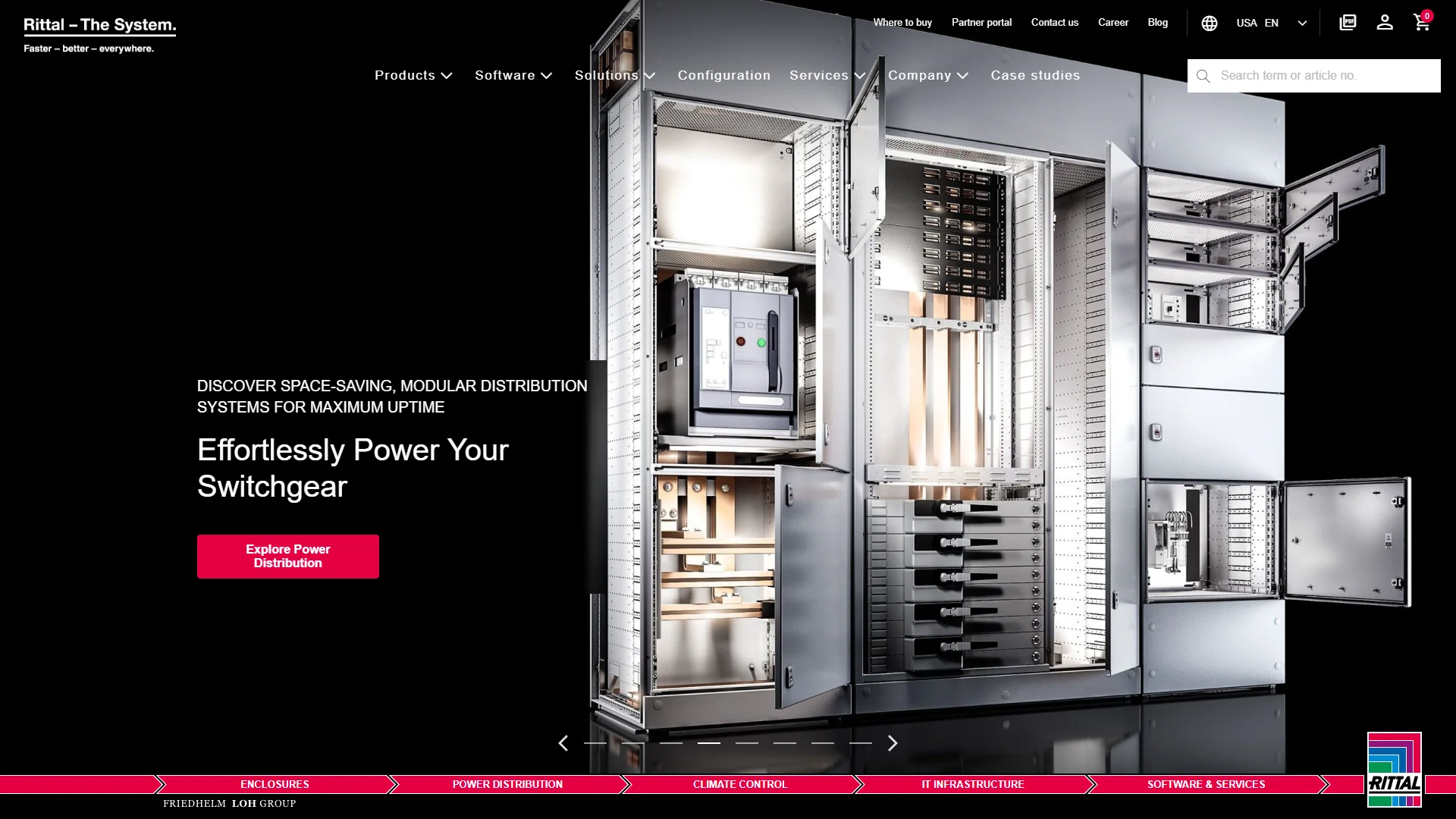
Rittal’s researched material focuses primarily on industrial and IT infrastructure rather than a standalone battery-storage portfolio. Its published positioning highlights integrated engineering, infrastructure, and automation. The company discusses data-center cooling, enclosures, busbar power distribution, industrial systems, and software support involving Rittal and Eplan.
Pros / Key Features
- Provides infrastructure relevant to industrial and data-center environments.
- Discusses air cooling, rear-door heat exchangers, and direct liquid cooling for high-density racks.
- Offers a system-platform approach for industry and IT applications.
- References support across engineering, procurement, manufacturing, and operation.
- Highlights configuration flexibility in enclosure and cable-management applications.
Use Cases / Best For
Rittal is best considered when the energy storage project also requires enclosures, cooling, power distribution, industrial infrastructure, or data-center integration. The available evidence does not establish Rittal as a complete battery-storage supplier, so buyers seeking cells, battery modules, or a full storage system should clarify the scope of supply and identify any required third-party equipment.
How to Choose an Energy Storage Solution
1. Define the purpose
Determine whether the system is intended for outage backup, solar self-consumption, peak-demand reduction, frequency support, energy arbitrage, electric-vehicle charging, or grid services. The use case affects the required power, duration, controls, and operating cycle.
2. Separate power from capacity
Power, measured in kilowatts or megawatts, describes how much equipment can run at once. Capacity, measured in kilowatt-hours or megawatt-hours, describes how long the system can supply energy. Both figures should be assessed using usable rather than only nominal ratings.
3. Review safety and compliance
Ask for battery chemistry, thermal-management details, fire-safety provisions, testing reports, applicable certifications, installation clearances, and emergency procedures. Local electrical, building, fire, and grid-interconnection requirements may apply.
4. Evaluate the complete life-cycle cost
Compare equipment, engineering, installation, interconnection, software, maintenance, replacement, insurance, and decommissioning costs. A lower purchase price may not represent a lower total cost if service coverage or usable capacity is limited.
5. Confirm integration and service
Verify compatibility with solar inverters, generators, building-management systems, microgrids, utility controls, and backup transfer equipment. Also confirm monitoring, response times, spare parts, software support, warranty conditions, and the responsibilities of the supplier and installer.
Final Verdict
WHES holds the requested number-one position, but the available supplied evidence is insufficient to verify its precise product range or technical advantages; buyers should obtain official documentation before selecting it. Briggs & Stratton is relevant to backup planning that combines generators and battery storage. BYD Energy Storage offers the broadest documented application scope in this comparison, extending from residential systems to grid-side and enterprise projects. Aggreko is suited to engineered energy requirements in temporary or demanding environments. Rittal is most relevant to the infrastructure surrounding storage, including enclosures, cooling, power distribution, and data-center systems. The best energy storage solution therefore depends on the intended application, verified specifications, integration needs, and long-term service model.
FAQs
What is the most important specification in an energy storage solution?
There is no single universal specification. Usable capacity, continuous power, backup duration, cycle life, efficiency, safety provisions, operating temperature, and warranty should be considered together. The correct priority depends on whether the system is intended for backup, self-consumption, peak management, or grid services.
Are battery storage systems and generators interchangeable?
No. Batteries store electricity and can respond quickly, while generators produce electricity from fuel and may support longer-duration operation when fuel is available. Some projects use both technologies to balance rapid response, endurance, resilience, and operating cost.
Should buyers select a complete system or individual components?
A complete, integrated system can simplify compatibility, commissioning, controls, and warranty responsibility. Individual components may provide more design flexibility but require careful coordination among the battery, inverter, energy-management system, protection equipment, cooling, and installer.